


Il Redentore.
 During our first visit to Venice we walked into a restaurant to make a reservation for lunch. When we entered, we saw no one, but as we got to the counter, the owner very slowly rose from behind it. The woman looked like she had slept very little or drunk very much. Or both. Writing down our reservation turned out to be a major effort for her. Twelve o’clock in the afternoon for instance became midnight. When the reservation had finally been noted correctly, she offered her sincere apologies. She had been very busy. When I suggested she had celebrated the Redentore festival, a broad smile appeared on her face, followed by a long and meaningful yeeeeeeeah. The Festa del Redentore is one of the most important Venetian festivals. It is closely associated with the Basilica del Santissimo Redentore, which is usually simply called Il Redentore.
History
In late 1575 Venice was struck by a terrible plague. It was unstoppable, and soon the number of dead became uncountable. In autumn of the next year the desperate authorities even decided to enact a lockdown: for one full week not a single Venetian was allowed to leave his house. It was not until 13 July 1577 that the authorities could formally declare that the plague was over. The number of victims was immense. Of a total population of about 175,000 souls, some 50,000 men, women and children had died.[1] The best-known victim was the elderly painter Titian, who in spite of his celebrity status was granted just a simple grave in the church of the Frari. It was not until the nineteenth century that the monumental tomb was erected for him to which he was entitled.

Il Redentore along the Canale di Giudecca.
Venice had undeniably been struck by a demographic disaster, but already in late 1576, when the number of victims began to drop, the Venetians concluded that it was time to begin looking towards the future again. They looked towards heaven as well, as the slow but certain defeat of the plague obviously had to be attributed to Jesus Christ the Saviour. As early as September of 1576, Doge Alvise I Mocenigo had promised to build the Saviour a grandiose new church on the island of Giudecca. The foundation stone for the church was laid on 3 May 1577. Giudecca had previously been called Spinalunga, “long thorn” or “long spine”, a name that referred to the shape of the island south of Dorsoduro. The later name Giudecca was for some time thought to derive from the Jews – giudei – who were required to live here in the centuries before they were housed in the Venetian ghetto, but this is probably a false etymology. It is much more likely that Giudecca refers to the giudicati or zudegà, the Venetians who had been convicted in a trial and exiled to the island.

The church, seen from the bell-tower of the San Marco.
The great architect Andrea Palladio (1508-1580) was hired to build Il Redentore. With a lot of justification the church is seen as one of his most successful works. Because of his death in 1580, early in the project, Palladio did not live to see the completion of the basilica (he did witness the large fire in the Palazzo Ducale on 20 December 1577, the next disaster that the Venetians had to cope with). After Palladio’s death work on the church was continued by the man who also gave Venice her Rialto bridge, Antonio da Ponte (1512-1597). Il Redentore was completed in 1592 and consecrated on 27 September of that year.

Il Redentore (back left) and Santa Maria della Salute (front right).
Since 21 July 1577, eight days after the plague had officially been declared over, the Festa del Redentore has been celebrated each year in the third weekend of July. The most important elements of the festival are a procession and mass on Sunday. From the Zattere – the quay of Dorsoduro named after the rafts that used to dock here – a pontoon bridge is built across the Canale di Giudecca, so that the procession can cross the water, enter the church and attend mass. The festival was already celebrated way before Il Redentore was finished: back then a wooden construction was used. In the days of the Venetian Republic, the procession was led by the Doge and his Signoria, but their role is currently performed by the Patriarch of Venice.[2] The Saturday evening before the procession and mass is used for festivities. Merry eating and drinking parties are held on the Zattere, and fireworks are discharged. It was clear that the owner of our restaurant had actively participated in the celebrations.

Pontoon bridge across the Canale di Giudecca.
Things to see

Interior of the church.
I visited the church on a Tuesday in July, not long after the Redentore festival had been held. Parts of the pontoon bridge across the Canale di Giudecca were still clearly visible (photo above). The centre part of the bridge had already been towed away to allow the safe passage of ships, but both outer ends were still in place. A few days later these were gone as well. It was very quiet in the church. The crowds of the festival were gone, and apart from an elderly couple and a cleric I was the only visitor. The church itself can normally be visited free of charge, but visitors will have to buy a ticket for the sacristy. A ticket for the San Marco should also provide access to the sacristy, but in my case this part of the building turned out to be open to the public for free anyway because of a temporary exhibition.
Andrea Palladio’s real name was Andrea della Gondola. Initially he worked as a stonemason, but then a meeting with the humanist Gian Giorgio Trissino (1478-1550) changed his life forever. It was Trissino who aroused his interest in Greco-Roman architecture and who nicknamed him Palladio, after the Greek goddess Pallas Athena. It is fairly evident that Palladio was inspired by classical architecture when building Il Redentore. Just take a look at the façade with its triangular pediments and columns with Corinthian capitals. On the other hand, the seven statues on the façade make clear that we are not dealing with a Roman temple, but with a Catholic church. On either side of the entrance are niches with statues of Saint Mark the Evangelist with his lion and Saint Franciscus of Assisi. One level up we see on the left Lorenzo Giustinian (1381-1456), the first Patriarch of Venice, and on the right Saint Antonius of Padova. All these statues were made by Giusto Le Court (1627-1679) and his studio. Even higher are two angels and Fides, the personification of Faith. She is holding a cross, chalice and sacred host. The highest position is of course reserved for Christ the Saviour. His statue adorns the lantern of the dome.

Resurrection – Francesco Bassano (the Younger).
The interior of the church can be summarised in a few words: classical, elegant, plain, and white. It was an interior that matched well with Palladio’s taste and that of the Capuchins, the Franciscan friars that administered the church and adjacent convent. The friars are still there, with the statues of Franciscus of Assisi and Antonius of Padova – the most important Franciscan saints – a clear sign of their presence (Lorenzo Giustinian was arguably an important Venetian, canonised in 1690 to boot, but he was not a Franciscan). The basilica has a single nave that is basically devoid of artworks. For art we must explore the chapels, counter-façade, high altar, choir and sacristy. The church has three chapels on either side. They have been decorated with paintings depicting events that took place during the life of Christ or after his death. In consecutive order we see:
- First chapel on the right: a Nativity by Francesco Bassano (1549-1592);
- Second chapel on the right: a Baptism of Christ from the school of Veronese (1528-1588);
- Third chapel on the right: a Flagellation of Christ from the school of Tintoretto (1518-1594);
- First chapel on the left: a Deposition from the Cross by Palma il Giovane (1548-1628);
- Second chapel on the left: a Resurrection by – again – Francesco Bassano;
- Third chapel on the left: an Ascension attributed to Tintoretto and assistants, including his son Domenico (1560-1635).
The counter-façade also has several interesting decorations. The grisaille painting is by Paolo Piazza (ca. 1560-1620), who upon joining the Capuchins changed his name to padre Cosimo (or Cosmo) da Castelfranco. He lived in the convent adjacent to the church. The painting refers to the liberation from the plague and the promise to build the church, as does the inscription below it. Below that inscription is a second painting, made by Pietro della Vecchia (1603-1678), who in the past was also known – incorrectly – as Pietro Muttoni. At first glance the painting appears to be another Nativity, but upon closer inspection this turns out not to be the case. The Virgin Mary is actually handing the Christ child not to Joseph, but to Saint Felix of Cantalice (1515-1587), a prominent Capuchin friar who had been beatified in 1625 (and who would be canonised in 1712, but this was of course still unknown to Pietro della Vecchia).


The high altar was designed by padre Giuseppe da Vicenza, also a Capuchin friar. It dates from ca. 1680. When exploring the choir, I discovered a perfectly sculpted relief on the back of the altar. It represents the Deposition from the Cross and is a work by Tommaso Rues (ca. 1633-1703). This sculptor was from South Tyrol, which explains his somewhat un-Italian name. The relief of the Ascent to Calvary on the front was also made by him. On the other hand, the crucifix and statues of – again – Saints Mark and Franciscus were made by Girolamo Campagna (ca. 1549-1625). Lastly, the sacristy also has a couple of highlights. Apart from many, many reliquaries, we find works by Veronese and Alvise Vivarini (died in 1503 or 1505) here. It is not allowed to take photos in the sacristy, so unfortunately I cannot show my readers any of these highlights.
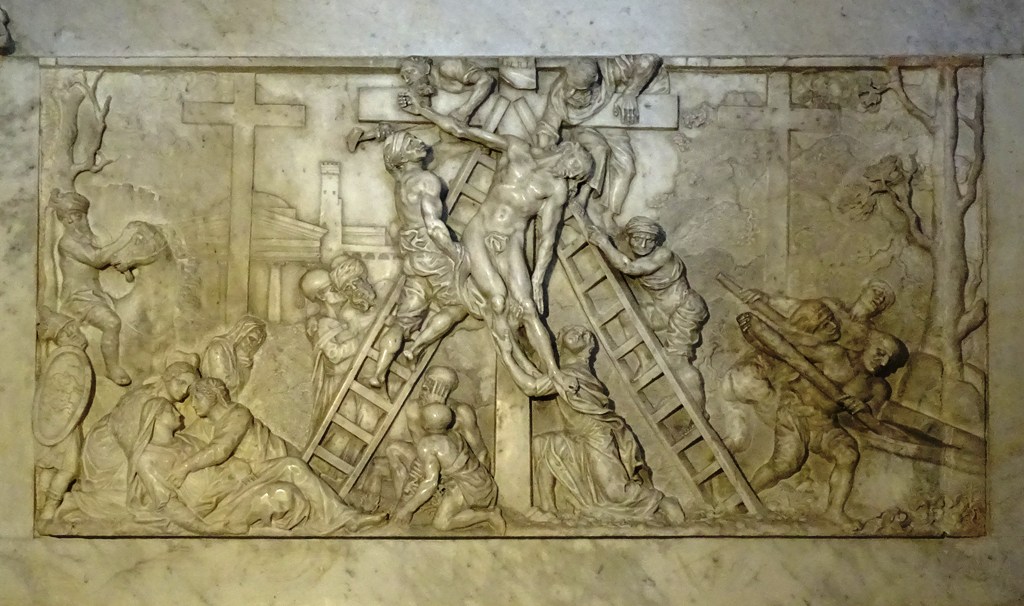
Deposition – Tommaso Rues.
Sources: Capitol travel guide Venice & Veneto (2012), p. 154, Trotter travel guide Northeast Italy (2016), p. 431-432, John Julius Norwich, ‘A History of Venice’ (2012), p. 494, The Churches of Venice: Giudecca and the information panels in the church.
Notes
[1] Numbers taken from John Julius Norwich, ‘A History of Venice’ (2012), p. 494.
[2] Doge Alvise I Mocenigo died on 4 June 1577, though not of the plague. His death not just prevented him from witnessing the completion of the Redentore church, but also from participating in the first Festa del Redentore. It was his successor Sebastiano Venier (1577-1578) who first crossed the water on 21 July 1577.